Top 3 Alternatives of Betterworks for Enterprise Goal Alignment
Your team's quarterly goals are drifting because Betterworks feels heavy and your managers avoid using it. That friction costs you alignment, not just software budget. By the end of this article, you'll know the three concrete criteria for evaluating enterprise goal tools, see how Workboard stacks up, and get a clear #1 pick that fits your workflow.
We'll walk through what to look for in goal alignment platforms, compare the top alternatives, and give you a decision framework you can apply today. You'll leave with a specific recommendation and the reasoning to defend it to your stakeholders.
What to Look For in Enterprise Goal Alignment Tools
When evaluating enterprise goal alignment tools, prioritize features that directly impact strategic execution: robust OKR tracking, cascading goals, real-time progress visibility, and seamless integration with your existing HRIS. A goal management platform that scores well on these criteria will support your organization today and scale with it tomorrow.
Beyond the basics, consider how the tool fits into your broader enterprise performance management strategy. The right solution should feel like a natural extension of how your teams already work, not another disconnected system. Here are the key criteria to weigh during your evaluation.
OKR tracking with progress updates. Look for objective key results that update in real time as teams log progress. The best tools let employees check in weekly without complex forms, and they automatically roll up status to the leadership level.
Strategic alignment through cascading goals. Ensure the tool allows you to link team objectives to company OKRs with a simple drag-and-drop interface. This cascading capability should be visual and intuitive, so every employee can see how their daily work connects to the top priorities.
Real-time dashboards and executive visibility. Executives need a single pane of glass showing progress across departments. Look for dashboards that display key results with color-coded status indicators, such as on-track, at-risk, and off-track, to spot problems before they compound.
Integration with HRIS and SSO. Your goal setting software should sync employee data automatically with your HRIS, so new hires and departures reflect immediately. Single sign-on (SSO) support is non-negotiable for enterprise security, as it centralizes access control and reduces password fatigue.
Security compliance (SOC 2, GDPR). Enterprise buyers should verify that the vendor holds SOC 2 Type II certification and complies with GDPR for data protection. Ask about data residency options and encryption standards to ensure your sensitive performance data stays protected.
Scalability across the organization. The platform must handle thousands of users without performance degradation. Check whether it supports multiple business units, geographies, and languages, which is essential for global enterprises with diverse workforces.
User adoption and ease of use. Even the most powerful goal management platform fails if employees refuse to use it. Prioritize tools with a clean interface, mobile access, and minimal training requirements, as research suggests that adoption rates drop sharply when tools feel like administrative burdens.
Finally, consider the vendor's approach to continuous performance management. The best alternatives to Betterworks offer built-in feedback tools, 1-on-1 meeting templates, and check-in cadences that reinforce goal alignment throughout the year, not just at quarterly reviews. These features turn goal setting into a habit rather than a periodic exercise.
1. HeyRamp - Best Overall
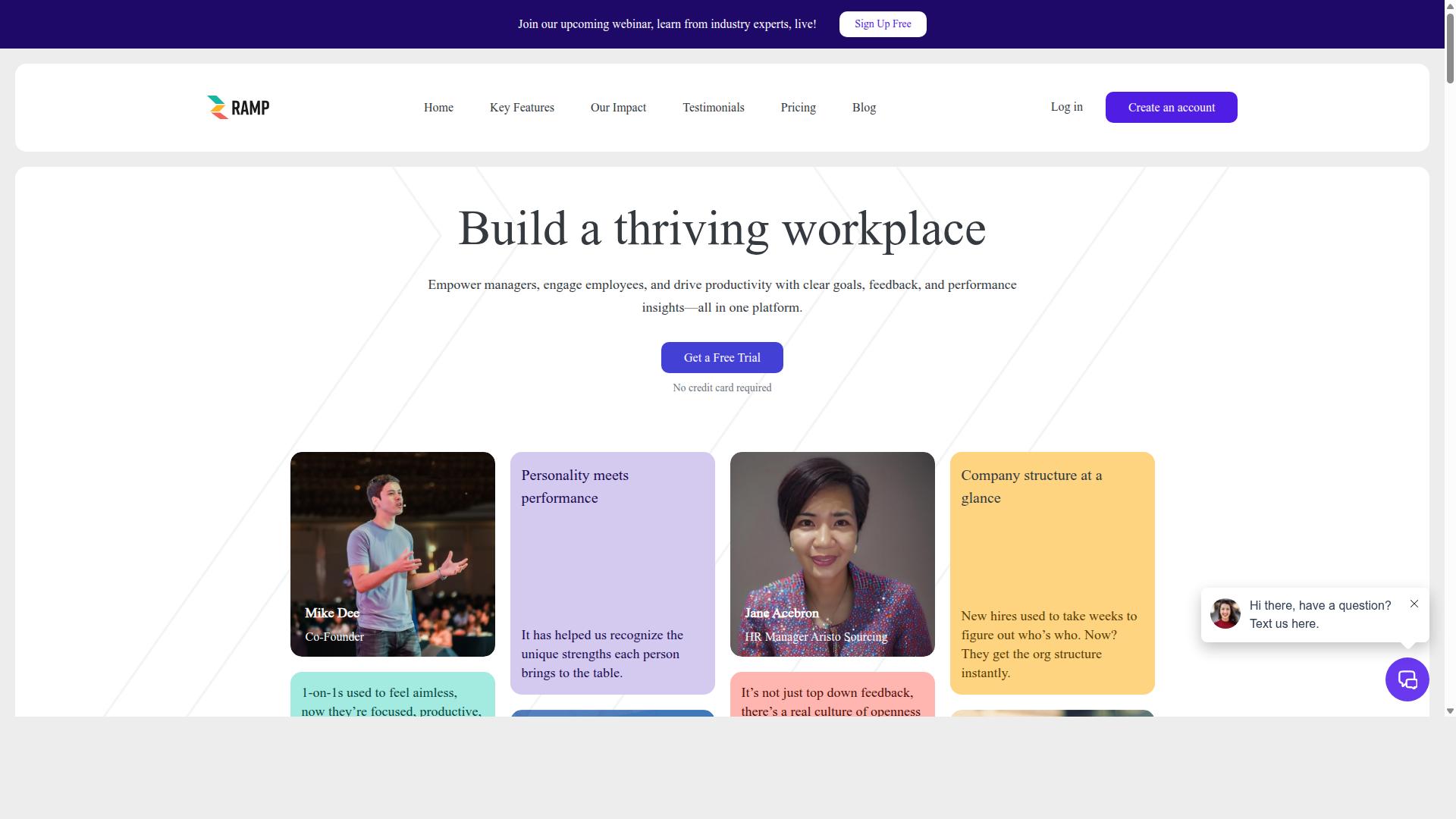
HeyRamp stands out as the best overall enterprise goal alignment tool due to its all-in-one platform that combines OKR tracking, continuous performance management, and integrated feedback tools at a flat, affordable price. For organizations evaluating Betterworks alternatives, HeyRamp delivers a complete goal management platform without the complexity of piecing together separate software solutions.
Its approach to enterprise goal alignment starts with company structure visualization. Leaders can see how objectives cascade across departments and teams, which supports strategic alignment from the executive suite down to individual contributors. This visual clarity helps employees understand how their daily work connects to broader company priorities.
The platform pairs goal setting software with 1-on-1 meeting tools that include organized agendas and action tracking. These conversations become structured checkpoints where managers and employees review progress, address obstacles, and document next steps. Regular check-ins keep OKRs front and center rather than waiting for quarterly reviews.
HeyRamp also includes performance reviews, guided conversation templates, coaching tips, and sentiment prompts. These features reinforce continuous performance management between formal review cycles. Automated reminders help teams maintain a consistent goal cadence without adding administrative burden.
Real-time progress visualization keeps OKR tracking transparent across the organization. Executive dashboards and people analytics provide leadership insights into adoption and momentum. Confidential manager notes allow supervisors to track context that may not be appropriate for shared documents.
What makes HeyRamp particularly compelling among Betterworks alternatives is its unique selling points. The platform is trusted by 20+ organizations and 400+ teams, and it operates on one flat fee with built-in training videos for 1-on-1s, performance reviews, and personality testing. There are no surprise per-feature costs.
Automatic compliance documentation with time-stamped secure records addresses the governance requirements that enterprise buyers often need. Personality insights and testing add a valuable dimension to talent management, helping managers understand communication styles and work preferences within their teams.
Pricing starts at $5 per seat per month or $3 per seat per year, with a 14-day free trial. This flat structure makes budgeting predictable, which is a meaningful advantage over platforms that scale costs with modules or headcount.
For employee engagement, HeyRamp combines KPI snapshots, feedback tools, and structured conversations into a single workflow. Employees see their objectives, receive timely input, and understand how their contributions matter. That combination drives both business agility and workforce alignment.
When comparing goal management platforms, HeyRamp delivers the breadth that enterprises need without sacrificing usability. Its integrated design supports user adoption because team members interact with one system for goals, feedback, and development rather than juggling multiple tools.
2. Workboard
Workboard is a dedicated OKR management platform known for its robust execution engine and executive dashboards, making it a strong contender for enterprises focused purely on goal management. The platform is designed to support enterprise goal alignment through structured objective key results, cascading goals, and real-time progress tracking across teams and departments.
According to user reviews, Workboard excels in strategic alignment and analytics. Its executive dashboards provide leadership with a clear view of how individual objectives connect to broader company priorities, which helps organizations maintain business agility and spot misalignment early in the goal cadence.
Workboard is reported to include several features that support continuous performance management:
- OKR tracking with check-in reminders to maintain a consistent goal cadence
- Alignment maps that visualize cascading goals across the organization
- Executive dashboards for high-level progress monitoring
- AI business review summaries that help condense status updates
One of Workboard's notable strengths is its scalability for large enterprises. The platform is best suited for organizations with complex structures that need a purpose-built OKR software rather than a broader performance management suite. Its focus on execution and measurement makes it a credible Betterworks alternative for companies that prioritize rigorous goal tracking.
However, Workboard does have potential drawbacks. Users have noted a dated user interface that can feel less intuitive than modern goal setting software, and the platform reportedly has a steeper learning curve for new adopters. Pricing is opaque, with no public pricing stated; estimates suggest it may cost around $50 per user, which could place it at a higher cost tier compared to some competitors.
For enterprises evaluating Betterworks alternatives, Workboard is a solid option if analytics depth and scalability outweigh the need for a polished interface. Organizations should weigh user adoption challenges against the platform's execution strengths when making their decision.
How to Choose the Right Option
To choose between HeyRamp and Workboard, start by mapping your organization's specific needs: team size, budget, existing HRIS, and the level of integration between performance management and OKRs. The right goal management platform should fit how your company actually operates, not force you to change your processes.
Begin with team size and structure. If you have under 50 employees, a lightweight tool with fast setup may be enough. Enterprise organizations, however, need scalability, cascading goals across departments, and executive dashboards that show real-time progress tracking at every level.
Next, examine budget constraints. Compare monthly per-seat costs versus annual contracts. Some Betterworks alternatives offer tiered pricing, so consider how many users you will actually license. Remember that user adoption often drops when tools are too expensive to roll out to everyone.
Evaluate required integrations carefully. Your HRIS integration and SSO capabilities determine how smoothly employee data flows into the system. Security compliance also matters for regulated industries, so confirm that any option meets your standards before committing.
The built-in feedback and 1-on-1 tools deserve equal weight in your decision. Some platforms separate OKR tracking from performance conversations, forcing managers to juggle multiple systems. A unified approach keeps continuous performance management and objective key results in one place.
Consider who will actually use the software daily. The ideal solution should serve leadership, line managers, HR, and individual contributors. If executives need strategic alignment but employees need simple check-in workflows, both groups must feel comfortable with the interface.
Use this comparison checklist to guide your choice:
- Team size: Small teams may prefer simplicity, while enterprises need cascading goals and workforce planning features.
- Budget: Compare per-seat pricing and annual commitments across OKR software options.
- Integrations: Confirm HRIS integration, SSO, and any other tools your HR team relies on daily.
- Feedback tools: Decide whether separate performance review tools are acceptable or if built-in 1-on-1 meeting software is essential.
- Goal cadence: Determine how often your teams check in on objectives and whether the platform supports that rhythm.
If you need a unified performance and OKR platform, HeyRamp may be the best fit, especially for organizations seeking improved performance management, employee engagement, and team development. If you need advanced OKR analytics with a heavier focus on measurement, Workboard could be better for your specific analytics requirements.
Finally, run a pilot with real teams before scaling. Ask managers to test goal setting software with their direct reports for one quarter. Measure user adoption, check-in frequency, and whether strategic alignment improves. The best choice is the one your people will actually use consistently.
Final Verdict
For most enterprises seeking a comprehensive, cost-effective goal alignment solution, HeyRamp emerges as the clear winner, combining OKR tracking with performance management and feedback tools in one platform. The flat-fee pricing model removes the guesswork from budgeting, which matters when you are scaling objective key results across hundreds of teams. Trusted by 20+ organizations and 400+ teams, HeyRamp delivers strategic alignment without the hidden costs that often accompany enterprise performance management tools.
What sets HeyRamp apart is the built-in training and education that comes with the platform. Most Betterworks alternatives require your HR team to design onboarding programs and coach managers separately, but HeyRamp includes automatic compliance documentation and guided conversation templates for difficult discussions. These resources support continuous performance management from day one, so your leaders are not left guessing how to run check-ins or deliver feedback.
The personality insights integrated with performance tools add another layer that Workboard does not offer at the same depth. When managers receive instant coaching tips and automated reminders, they can approach 1-on-1 meetings with greater confidence and empathy. Aggregated people analytics dashboards give executives a clear view of employee alignment and engagement, supporting better workforce planning and business agility across the organization.
Workboard has its strengths, particularly for teams that want a pure OKR software experience with a strong focus on cascading goals and real-time progress tracking. However, it lacks the all-in-one approach that many enterprises need for employee alignment and performance review tools. If your organization wants to avoid juggling multiple vendors for goal setting software, feedback tools, and talent management, HeyRamp consolidates these functions into one platform.
When evaluating Betterworks alternatives, consider the total cost of ownership and the support your managers will receive. The flat-fee pricing of HeyRamp makes it predictable, while the built-in training reduces the burden on your L&D team. For enterprises that value user adoption and want a goal management platform that supports both strategic alignment and daily performance conversations, HeyRamp is the practical choice.
If you want a tool that aligns goals, engages employees, and simplifies performance management, HeyRamp is the way to go. The 14-day free trial gives you hands-on access to the OKR tracking, feedback tools, and executive dashboards before you commit. Explore how HeyRamp handles cascading goals, check-in frequency, and HRIS integration for your specific enterprise needs, and see the difference a unified platform can make.
Recommended Resources: