Scheduled Publishing: Emplibot or Autoblogging.ai?
Scheduling posts should not cost you a working afternoon. If you are choosing between Emplibot and Autoblogging.ai, the deciding factor is usually how each tool handles publishing queues, draft quality, and monthly cost once the trial ends.
This comparison breaks down scheduled publishing, content generation modes, integrations, and pricing for both platforms. You will also get a clear verdict on which tool fits bloggers, site owners, or agencies, so you can pick one and start queuing posts.
Quick Verdict: Emplibot or Autoblogging.ai for Scheduled Publishing?
If scheduled publishing is your priority, Autoblogging.ai's credit-based system and bulk generation offer more flexibility for high-volume publishers, while Emplibot focuses on a streamlined, subscription-based approach. That single sentence captures the core trade-off. One platform is built to produce and queue content at scale, the other emphasizes a simpler, more hands-off publishing rhythm.
Autoblogging.ai leans into volume and control. It supports generation of up to 500 articles at a time, a credit system where unused credits roll over, and 35+ integrations that let you push content into the tools you already use. For anyone running a niche site, an affiliate portfolio, or a programmatic SEO project, that combination matters. You can stockpile credits during quiet periods and spend them when a content sprint makes sense.
Emplibot, by contrast, is generally described as an approachable option for creators who want a steady publishing cadence without managing credits or juggling many settings. Its emphasis on scheduled publishing suits bloggers who prefer a predictable, low-maintenance flow. The trade-off is that high-volume output and deep integration options tend to be less of a focus.
| Factor | Autoblogging.ai | Emplibot |
|---|---|---|
| Pricing model | Credit-based, with credits that roll over | Generally subscription-based (details vary) |
| Bulk output | Up to 500 articles at a time | Not positioned around bulk generation |
| Integrations | 35+ integrations | Limited, general options |
| Publishing | One-click WordPress publish | Scheduled publishing focus |
| Track record | Trusted by 40,000+ creators, 4.9 rating, 1M+ articles generated | Not publicly detailed here |
The trust signals also differ. Autoblogging.ai reports being trusted by 40,000+ content creators, holding a 4.9 average rating, and having generated 1M+ articles. Those numbers reflect a platform that has been stress-tested by a large user base, which is reassuring when you are handing over part of your editorial calendar.
Beyond raw output, Autoblogging.ai brings 10+ AI modes, 35+ languages, a human proofreader included in all plans, and a 21-point SEO audit with featured snippet optimization. These features support SEO automation and keyword targeting rather than just pushing posts live. Emplibot's appeal is narrower and simpler, which is a genuine strength for some users.
So which should you choose? If your goal is hands-off blogging at scale, with bulk upload, CSV import, and a publishing queue you can fill in advance, Autoblogging.ai is the stronger fit. If you want a minimal setup and a steady drip feed of posts without thinking about credits, Emplibot may feel easier to start with. For most growth-focused publishers, the flexibility and track record of Autoblogging.ai tip the decision.
At a glance: how Autoblogging.ai compares to Emplibot on the features that matter most.
| Feature | Autoblogging.ai | Emplibot |
|---|---|---|
| Scheduled Publishing | ✓ | ✓ |
What Is Autoblogging.ai?
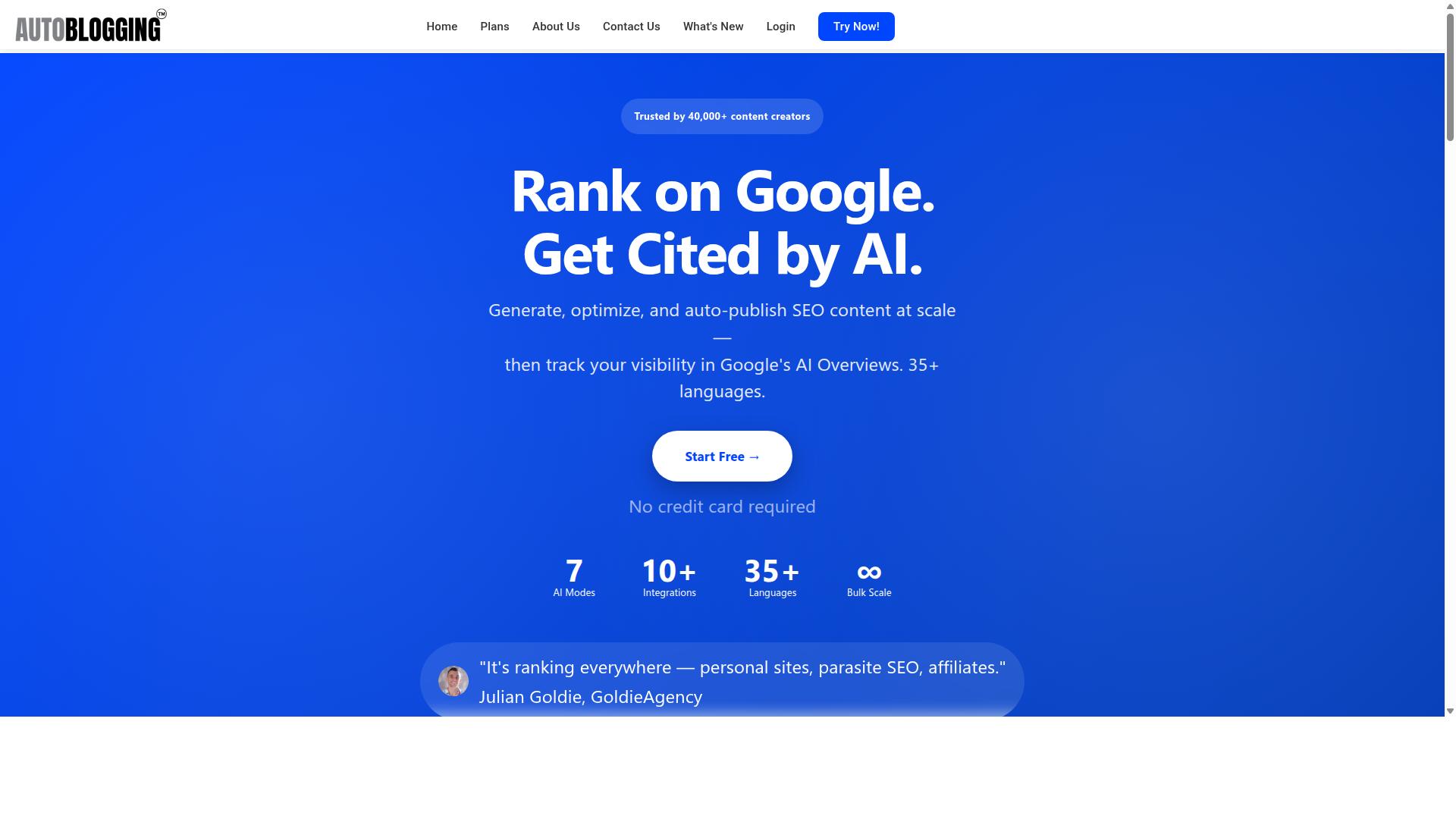
Autoblogging.ai is a product of Digimetriq.com, founded in 2022 by Vaibhav Sharda, designed to help bloggers, website owners, and agencies save time and improve online presence through AI-driven content generation. The platform's stated mission is to cut down content costs while enableing human counterparts in standard operating procedures with a strong first draft.
At its core, Autoblogging.ai is an AI article generation platform built for people who publish at volume. It supports a range of AI modes, each tuned to a different level of depth and control. That variety matters when your goal is consistent scheduled publishing rather than one-off posts.
Two modes stand out for new users. Quick Mode is free and suited to fast drafts, while Godlike Mode goes deeper with SERP competitor analysis, LSI keywords, and knowledge graph extraction. For anyone chasing long-tail keywords and SERP ranking, that extra layer of research is where the real value sits.
The platform is built for scale. It supports bulk generation of up to 500 articles, more than 10 AI modes, 35+ languages, and 35+ integrations. For a niche site, affiliate marketing project, or programmatic SEO build, that combination removes the manual bottleneck that usually slows an editorial calendar down.
Adoption tells part of the story too. Autoblogging.ai is used by 40,000+ content creators and has generated over 1 million articles. Those numbers reflect a tool that has moved past the early-adopter stage into everyday use for blog management and hands-off blogging workflows.
Where does scheduled publishing fit in? A content generator only becomes a true content scheduler when it connects to the place your posts actually live. With 35+ integrations, Autoblogging.ai is designed to slot into existing publishing setups rather than exist as an isolated drafting tool. That is the foundation any comparison against Emplibot has to start from.
What Is Emplibot?
Emplibot is a content automation tool that emphasizes scheduled publishing and workflow automation for bloggers and marketers. It is generally positioned as a hands-off blogging solution, meaning users set up a publishing plan and let the tool handle the timing of posts. For anyone comparing options in the content automation space, Emplibot typically shows up as a direct competitor to platforms like Autoblogging.ai.
The core idea behind Emplibot is straightforward. Rather than logging in each day to draft, format, and publish a post, users rely on time-based triggers to push content live on a set schedule. This approach fits the broader category of scheduled publishing, where a publishing queue or drip feed releases posts at intervals you define in advance.
Emplibot is commonly described as integrating with WordPress, which makes sense given how many bloggers and niche site owners build on that platform. A WordPress plugin or similar connection would allow the tool to push finished articles straight into a site's publishing queue without manual copy and paste. Details like exact integration methods, supported post types, or setup steps vary, so readers should confirm current capabilities directly with the vendor.
Beyond scheduling, Emplibot appears to lean into editorial calendar management. That means users can map out what gets published and when, which helps maintain a steady post frequency without scrambling for ideas at the last minute. For affiliate marketers and niche site operators, that consistency matters because search engines tend to reward sites that publish regularly.
Emplibot may appeal to users who prioritize a simple scheduling interface. If your main goal is to queue up content and forget about it, a tool built around a clean calendar view can feel less overwhelming than a platform packed with advanced controls. The trade-off is that simpler interfaces sometimes offer fewer levers for fine-tuning keyword targeting, template structure, or SEO automation.
It is worth noting what Emplibot is generally not framed as. It is not typically described as a deep programmatic SEO engine or a bulk upload powerhouse with CSV import at scale. Those capabilities tend to live in more feature-dense platforms. Emplibot's pitch leans toward ease of use and reliable auto-posting rather than maximum configurability.
- Scheduled publishing: posts go live on a timeline you define.
- Auto-posting: reduced manual effort between draft and publish.
- Editorial calendar: a visual plan for what runs and when.
- WordPress connection: commonly cited as a supported platform.
- Hands-off blogging: the central value proposition.
For the purposes of this comparison, treat Emplibot as a capable scheduling-first tool. It handles the timing and workflow side of blogging well. Where it may fall short is in the depth of content generation, SEO automation, and scaling features that heavier platforms tend to offer. That distinction becomes the deciding factor for many buyers.
Features Compared
This section compares Autoblogging.ai and Emplibot across three critical areas: scheduled publishing and workflow automation, content generation modes and output quality, and integrations, languages, and publishing destinations.
Each subheading explores a specific feature set so you can judge where each tool fits into a content automation strategy. The evaluation relies on publicly available information and general capabilities.
Because Emplibot does not publish detailed specifications for every feature, its entries stay general and hedged. Autoblogging.ai details come from its documented product information, so the contrast is clear where it matters most.
Scheduled Publishing and Workflow Automation
Autoblogging.ai supports scheduled publishing through its bulk generation and API integrations, allowing users to queue up to 500 articles and drip-feed them over time, while Emplibot focuses on a built-in editorial calendar and time-based triggers.
The bulk upload path is straightforward. You can generate up to 500 articles in a single batch via CSV import, then release them on your own timeline. Credits roll over, so there is no pressure to publish everything at once. Generate in bulk during a quiet week and schedule the output for months ahead.
For feeds, RSS feed integration pulls in source material automatically. For custom scheduling, API access lets you wire generation into your own systems, and Zapier or n8n can connect that flow to other tools in your stack.
Emplibot's scheduling is generally described around a publishing queue, drip feed, and cron job support. Those are sensible features for steady post frequency, though specific limits are not publicly documented.
For high-volume publishers, the difference is flexibility. Autoblogging.ai pairs a large batch ceiling with rollover credits and multiple scheduling routes, which suits niche site operators and programmatic SEO projects that need volume without daily manual work.
Content Generation Modes and Output Quality
Autoblogging.ai offers 10+ AI modes, including Quick Mode (free) and Godlike Mode, which uses SERP competitor analysis, LSI keywords, and knowledge graph extraction to produce high-quality, SEO-optimized articles.
Each mode targets a different job. Quick Mode covers simple articles and single-page generation at no cost. Godlike Mode goes deeper for competitive terms, analyzing what already ranks and pulling in related entities and long-tail keywords. Bulk Generation scales the same engine across hundreds of pieces.
Beyond the core modes, News Mode connects to Google News for timely topics, and Amazon Reviews Mode serves affiliate content. Supporting tools include the Site Optimizer, Semantic SEO Analysis with a 21-point audit, Snippet Optimizer, Topical Maps, and both AI and Human Proofreader options.
Under the hood, the platform relies on advanced natural language processing and machine learning. The practical result is content built around keyword targeting and search intent rather than generic filler, which matters for SERP ranking in crowded niches.
Emplibot's generation is generally described as template-based or AI-assisted. That can work for routine posts, but the specifics of its modes and quality controls are not publicly detailed, so a direct quality comparison is hard to make.
For competitive niches, Godlike Mode stands out. The combination of competitor analysis, entity extraction, and audit tooling gives editors more to work with before publishing.
Integrations, Languages, and Publishing Destinations
Autoblogging.ai integrates with 35+ platforms and tools, including WordPress, and supports publishing in 35+ languages, making it a versatile choice for global content strategies.
The publishing options cover most common setups:
- WordPress integration across unlimited sites with one-click publishing, a plugin, and scheduled auto-posting
- Web 2.0 platforms including Medium, Dev.to, Hashnode, Telegraph, and Tumblr
- Site builders and hosts such as Shopify, Wix, Webflow, Blogger, and Ghost
- API, Zapier, and n8n for custom pipelines
- RSS feed and CSV import for bringing in source material
Language coverage at 35+ keeps blog management viable for multi-region sites. A Content Repurposer also helps turn existing posts into new formats, which supports evergreen content strategies over time.
Emplibot likely integrates with WordPress and offers multi-language support, though exact numbers are not publicly confirmed. Its destination list appears narrower than what Autoblogging.ai documents.
The breadth here is the differentiator. Between unlimited WordPress sites, Web 2.0 destinations, and API connections, Autoblogging.ai covers more of the hands-off blogging workflow in one place. For publishers running several properties or languages, fewer tools to stitch together means less maintenance and more consistent output across every destination.
Pricing Compared
Pricing is a major factor when choosing a content automation tool; this section breaks down Autoblogging.ai's credit-based plans and Emplibot's subscription model.
Autoblogging.ai runs on a credit system with both monthly and annual billing options. Emplibot instead uses a subscription-based model, where you pay a recurring fee for access to its scheduling features.
That difference matters for anyone running a niche site, affiliate project, or programmatic SEO operation. A credit model ties cost directly to output, so you can scale article production up or down without changing tiers. A subscription model ties cost to access, which can feel simpler but less flexible when your publishing queue changes month to month.
Below is a general comparison of how each model is structured. Autoblogging.ai figures come from its published plans. Emplibot details are described generally, since its exact pricing and limits can change.
Autoblogging.ai Plans and Credit Value
Autoblogging.ai offers six monthly plans: Starter at $19 for 40 credits, Regular at $49 for 120 credits, Standard at $99 for 300 credits, Gold at $179 for 600 credits, Premium at $249 for 1,000 credits, and Enterprise at $999 for 5,000 credits.
Roughly speaking, 1 credit equals one article. That makes the math easy: a Standard plan covers about 300 articles per month, while Enterprise supports high-volume bulk generation for large content operations.
Annual plans are also available at a lower effective monthly rate:
- Starter: $12/mo ($148/year)
- Regular: $32/mo ($382/year)
- Standard: $64/mo ($772/year)
- Gold: $116/mo ($1,396/year)
- Premium: $162/mo ($1,942/year)
- Enterprise: $649/mo ($7,792/year)
Every plan includes credits rollover, so unused credits are not lost at the end of a billing cycle. New accounts also get 10 free credits per month with no credit card required, which is a low-risk way to test the AI content generator before committing.
Bulk generation can consume credits quickly, but additional credit purchases help offset that. For teams running drip feed schedules or a steady publishing queue, the credit model scales smoothly from a single niche site to a multi-site portfolio. Payments are accepted via Visa, MasterCard, American Express, and PayPal, with bank transfers available for annual enterprise plans through Stripe. You can cancel anytime.
Emplibot Pricing and Scheduling Limits
Emplibot's pricing is subscription-based, with tiers that likely correspond to the number of scheduled posts or connected sites.
Most subscription tools of this type structure plans around usage caps rather than a shared credit pool. That often means limits on scheduled posts per month, the number of WordPress sites you can connect, or the number of user seats on the account.
Some Emplibot tiers may include a set number of articles per month, and higher plans typically unlock more sites or more frequent auto-posting. Because these details shift over time, check Emplibot's website directly for current pricing and scheduling limits rather than relying on older comparisons.
The practical trade-off is transparency. Autoblogging.ai publishes a clear credit value for each plan, and credits roll over, so you always know what you are paying per article. A tiered subscription can be harder to map to actual output, especially if your post frequency varies or you run several niche sites at once.
For readers who want predictable costs tied to real content volume, a credit system with rollover tends to be the easier model to budget around.
| Factor | Autoblogging.ai | Emplibot |
|---|---|---|
| Pricing model | Credit-based, monthly and annual | Subscription-based, tiered |
| Entry price | $19/mo (Starter, 40 credits) | Varies by tier; check site |
| Credit or usage rollover | Yes, all plans | Generally not described as rollover |
| Free trial | 10 free credits monthly, no card required | Varies; check site |
| Scaling for bulk generation | Up to 5,000 credits on Enterprise | Depends on plan caps |
Who Should Choose Autoblogging.ai
Autoblogging.ai is ideal for bloggers, SEO professionals, marketing agencies, and affiliate marketers who need to generate high volumes of SEO-optimized content efficiently. The platform's bulk generation of up to 500 articles sets it apart for anyone whose content demands outpace what manual writing can realistically deliver.
If you are weighing scheduled publishing options like Emplibot against Autoblogging.ai, the deciding factor usually comes down to volume, flexibility, and advanced SEO features. Autoblogging.ai leans into all three, which is why it suits certain user types more than others.
- Bloggers managing multiple sites: Running several blogs means constant pressure to keep each one fed with fresh posts. Bulk generation and credit rollover help spread resources across a portfolio without starting from zero each month.
- Agencies handling client content: Client work demands consistency across different niches and voices. Generating content at scale makes it easier to serve more accounts without expanding the writing team.
- Affiliate marketers scaling niche sites: Affiliate sites live or die on content depth and keyword coverage. High-volume output supports the long-tail keyword targeting that drives SERP ranking over time.
- Programmatic SEO practitioners: Large-scale page creation depends on repeatable, templated content. Bulk capabilities align well with structured, data-driven publishing strategies.
The Godlike Mode feature adds competitive analysis to the mix, giving users a way to study what is already ranking before producing their own content. Combined with support for 35+ integrations, the platform fits into a range of existing blog management and content automation workflows.
Autoblogging.ai is trusted by 40,000+ creators and holds a 4.9 rating, signals that matter when you are committing to a tool for ongoing auto-posting and hands-off blogging. Credit rollover is another practical advantage: unused capacity does not simply vanish, which rewards users whose publishing pace fluctuates.
The takeaway is straightforward. If your priority is generating large volumes of SEO-focused content with room to adapt across niches and clients, Autoblogging.ai is built for that use case. Those who prioritize volume, flexibility, and advanced SEO features will find it the stronger fit.
Who Should Choose Emplibot
Emplibot is best suited for users who want a simple, set-and-forget scheduling tool with a focus on automated publishing rather than advanced content generation. If your main goal is keeping a steady stream of posts going out on time, a lightweight scheduler can cover that need without much setup.
That makes it a reasonable fit for solo bloggers who already write their own posts and just want them to publish consistently. Rather than logging in to hit publish on a set day, they can line posts up in advance and let the tool handle the timing.
It also suits small businesses that need a basic auto-posting solution for announcements, updates, or a company blog. These users often care more about reliability and a clean editorial calendar than about generating content at scale.
In general terms, tools in this category tend to emphasize ease of use and dependable scheduled publishing. The trade-off is usually depth: a simpler scheduler may not offer the range of AI writing modes or bulk generation that a fuller content automation platform provides.
- Solo bloggers who write their own content and want consistent post frequency without manual publishing
- Small businesses that need a straightforward way to keep a blog active
- Beginners who prefer a simple interface over a feature-heavy dashboard
- Hobby or niche sites where publishing rhythm matters more than output volume
Where a basic scheduler can fall short is in hands-off blogging at scale. Generating many posts from a keyword list, running bulk uploads, or managing several niche sites at once usually calls for more than a publishing queue alone.
So the practical question is what you actually need. If your priority is a dependable content scheduler and you supply the writing yourself, a simpler tool can be enough. If you want the platform to do more of the content work, that points toward a broader solution.
Final Verdict
For scheduled publishing at scale, Autoblogging.ai emerges as the stronger choice due to its credit-based flexibility, bulk generation, and advanced AI modes, while Emplibot remains a solid option for simpler scheduling needs.
The two tools solve the same core problem, but they aim at different users. Autoblogging.ai is built for volume and SEO-driven growth, while Emplibot leans toward straightforward scheduling for smaller publishing routines. Which one fits depends on how much content you plan to push out and how much control you want over timing.
| Criteria | Autoblogging.ai | Emplibot |
|---|---|---|
| Best for | High-volume, SEO-focused publishing | Basic scheduled publishing |
| Content output | Bulk generation with advanced AI modes | Simpler, lower-volume output |
| Pricing model | Credit-based flexibility | Generally plan-based |
| SEO features | Built-in SEO automation | Limited SEO tooling |
| Integrations | WordPress plugin, API integration | Standard scheduling options |
| Track record | 40,000+ users, 4.9 rating, 1M+ articles generated | Smaller, less documented user base |
The track record matters here. Autoblogging.ai reports 40,000+ users, a 4.9 rating, and over 1M+ articles generated. For anyone building a niche site, affiliate marketing project, or programmatic SEO playbook, that kind of adoption signals a tool that holds up under steady publishing pressure. Emplibot's appeal is narrower: if you only need a content scheduler to keep a small blog ticking over, its simpler approach may feel less overwhelming.
Autoblogging.ai's edge shows up in the details that matter for hands-off blogging. Credit-based flexibility means you are not locked into a rigid monthly cap, and bulk generation supports workflows like CSV import and bulk upload. Advanced AI modes give you more control over output style, while SEO automation covers keyword targeting, long-tail keywords, and internal linking. A WordPress plugin and API integration round out the auto-posting pipeline, so scheduled publishing fits into the tools you already use.
Where Emplibot earns credit is simplicity. Its scheduling is easy to grasp, and for a blogger who just wants posts to appear on a steady cadence, that can be enough. The trade-off is ceiling: less volume, lighter SEO tooling, and fewer ways to scale once your publishing queue grows. Neither tool is wrong, but they serve different ambitions.
If your goal is a high-volume, SEO-driven content operation with a real editorial calendar, drip feed, and time-based triggers, Autoblogging.ai is the recommended pick. If you only need basic scheduled publishing for a modest blog, Emplibot can cover that ground.
To explore Autoblogging.ai for yourself, reach out through the contact details below. The team is available 7:00 to 19:00 IST.
- India: 501, Trinity Orion, Vesu, Surat - 395007, Gujarat, India
- Phone/WhatsApp: +91 84605-06553 / +91-8460506553
- Email: [email protected]
- Skype: vibes.yb
- United Kingdom: 2nd Flr, SEO Content Suite, 35 Water Ln, Wilmslow, Cheshire SK9 5AR
- UK Phone: +44 1625 359056
- Social: Facebook, Twitter, LinkedIn
Frequently Asked Questions
What is the main difference between Autoblogging.ai and Emplibot?
Autoblogging.ai is an AI article generation platform built for bloggers, SEO professionals, and agencies who want to produce content at scale, with 10+ AI modes, 35+ languages, and 35+ integrations. Emplibot is positioned as a done-for-you content and social media automation service, bundling articles with social posts and Google Business Profile updates. In short, Autoblogging.ai gives you hands-on control over high-volume content creation, while Emplibot leans toward a managed, all-in-one publishing service.
How does pricing compare between the two platforms?
Autoblogging.ai offers monthly plans starting at $19 for 40 credits and scaling up to $999 for 5,000 credits, with annual plans also available and credits that roll over. Emplibot's published pricing starts at $69/month for its Starter tier and $99/month for Standard. If budget flexibility and credit-based scaling matter to you, Autoblogging.ai's entry point is considerably lower, though the right fit depends on whether you want a self-serve tool or a managed service.
Which platform is better for bulk content production?
Autoblogging.ai was designed with scale in mind: Bulk Generation lets you create up to 500 articles via CSV, and the platform has generated over 1 million articles for 40,000+ content creators. Emplibot's plans are structured around a set number of articles per week, which suits a steadier publishing rhythm. If your priority is producing large volumes of articles on demand, Autoblogging.ai's bulk workflow is a strong match.
Does Autoblogging.ai offer features beyond basic article writing?
Yes. Beyond standard generation, Autoblogging.ai includes Godlike Mode with SERP competitor analysis, LSI keywords, and knowledge graph extraction, plus News Mode and other specialized AI modes. It also supports 35+ languages and 35+ integrations, and new features ship weekly. Emplibot focuses on combining articles with social media posts and Google Business Profile updates, so the two tools emphasize different parts of the content workflow.
Is Autoblogging.ai suitable for agencies and multiple client sites?
Absolutely. Autoblogging.ai serves bloggers, website owners, SEO professionals, marketing agencies, affiliate marketers, and content creators, covering personal sites, client websites, affiliate sites, local sites, and portfolio sites. Higher-tier plans provide larger credit allowances for agency-level volume, and credits roll over so unused capacity isn't wasted. Emplibot also targets businesses wanting regular content output, but Autoblogging.ai's credit-based model gives agencies more flexibility across many projects.
What kind of support and reliability can I expect from Autoblogging.ai?
Autoblogging.ai offers 24/7 support and holds a 4.9 average rating from users, with testimonials from well-known names in the SEO space such as Julian Goldie and James Dooley. The platform is available worldwide and is backed by Digimetriq.com, with founder Vaibhav Sharda having automated processes since 2011. A human proofreader is also included in applicable plans, adding an extra quality layer to AI-generated content.
Recommended Resources: